
Banner placeholder — (728x90 / 320x100)
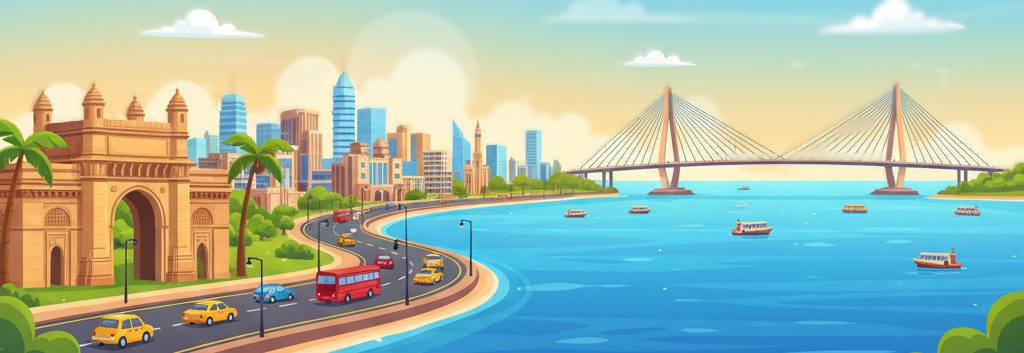
| Nickname | - City of Dreams - Financial Capital of India |
| Area (MCGM) | 603 Km2 |
| Population (City Proper) | ~12.5 million |
| Population (Metro Region) | ~23 Million |
| Population Density | Very High, one of the densest city in the world |
| Official Language | Marathi |
| Other Languages | Hindi, English, Gujarati, Tamil, Urdu, various regional languages |
| Time Zone | IST (GMT + 5:30) |
| Co-Ordinates | 19.0760°â€¯N, 72.8774°â€¯E |
| Climate | Tropical; hot summers, heavy monsoon (Jun–Sep) mild winters (Nov–Feb) |
| Seismic Zone | Zone III (moderate earthquake risk) |
Mumbai, originally a collection of seven islands, has a history that stretches back centuries. The earliest known settlers were the Koli fishing communities who lived along the coastal creeks, relying on the Arabian Sea for sustenance and trade. Over time, the islands witnessed successive waves of rulers, including local dynasties, the Portuguese in the 16th century, and eventually the British East India Company.
The British recognized the city’s strategic potential and initiated major land reclamation projects, most notably the Hornby Vellard in the late 18th century, which connected the seven islands into a single landmass.
This transformation laid the foundation for Mumbai’s emergence as a commercial and administrative hub. Industrialization in the 19th century attracted migrants from across India, establishing the city as a center of trade, finance, and industry.
The 20th century saw the growth of media and entertainment sectors, particularly the film industry, contributing to the city’s cosmopolitan character. In 1995, the city’s name officially changed from Bombay to Mumbai, honoring MumbÄÂ Devi, the patron goddess of the original Koli community, while reflecting the city’s evolving identity as a modern metropolis.
Situated on the Konkan Coast of western India, Mumbai occupies a narrow strip of land formed through extensive land reclamation and urban development.
Mumbai city lies along the Arabian Sea and features a mix of low hills, coastal plains, and mangrove wetlands. Its natural deep-water harbor has historically facilitated trade and shaped urban growth.
Mumbai experiences a tropical climate with distinct seasons. Summers, from March to May, are hot and humid, while the southwest monsoon from June to September brings heavy rainfall that replenishes water resources but also tests urban drainage systems. Winters, from November to February, are mild and dry, offering the most comfortable weather for residents and visitors.
Mumbai city also falls under Seismic Zone III, indicating a moderate earthquake risk. Despite intense urbanization, Mumbai maintains pockets of greenery such as parks, mangrove belts, and nature reserves that provide environmental balance and recreational opportunities.
Mumbai is India’s most populous metropolitan area, with over 23 million residents in the larger Mumbai Metropolitan Region (MMR) and approximately 12.5 million in the city proper.
Mumbai population density ranks among the highest globally, reflecting its status as an economic magnet and cultural melting pot. Mumbai residents come from diverse linguistic, cultural, and religious backgrounds, including Marathi, Gujarati, North Indian, South Indian, and international communities. Hinduism, Islam, Christianity, Jainism, and Sikhism coexist alongside other faiths, contributing to a rich cultural and social tapestry.
Migration to Mumbai city for employment has historically driven population growth, from textile mills and ports in the 19th century to modern IT, finance, and media sectors. Neighborhoods exhibit varying socioeconomic patterns, from high-density residential areas to affluent urban districts, showcasing the city’s complex demographic landscape.
Mumbai is India’s financial and commercial powerhouse, contributing a significant share of the national GDP and acting as the hub for foreign trade, corporate headquarters, and financial services.
Mumbai city houses major institutions such as the Bombay Stock Exchange (BSE), the Reserve Bank of India (RBI), and the National Stock Exchange (NSE). Industries have diversified from traditional textile mills and port-based commerce to modern finance, information technology, media, real estate, and entertainment.
Mumbai logistics and port infrastructure, including the Mumbai Port Trust and Jawaharlal Nehru Port Trust (JNPT), support international trade and supply chains.
Mumbai’s Urban Public Transport network is extensive, encompassing the Mumbai Suburban Railway, metro lines, monorail, buses, and iconic lunch delivery systems like the Dabbawalas.
Mumbai's Road infrastructure includes expressways, bridges, and coastal roads designed to connect the densely populated suburbs with the central business districts. Urban redevelopment, smart city initiatives, and ongoing infrastructure projects aim to balance growth, traffic management, and housing needs while enhancing quality of life.
Mumbai’s cultural identity is shaped by the coexistence of tradition and modernity. Mumbai city celebrates a wide array of festivals, reflecting its religious and regional diversity, including Ganesh Chaturthi, Diwali, Eid, and Christmas.
Mumbai culinary culture is vibrant, ranging from regional specialties to global cuisines, with street food, traditional dishes, and contemporary dining options contributing to the city’s gastronomic reputation.
Arts and creative industries flourish in Mumbai, with theaters, music venues, galleries, and media enterprises enhancing its cultural landscape. Urban lifestyle is fast-paced, yet residents have access to promenades, parks, fitness centers, and wellness facilities that balance city life.
The cosmopolitan ethos encourages entrepreneurial endeavors, creative expression, and a blending of multiple cultural influences that define Mumbai as a city of opportunities, innovation, and resilience.
Mumbai is home to some of India’s most prestigious educational and research institutions. Universities such as the University of Mumbai and SNDT Women’s University offer a wide range of academic programs, while colleges including St. Xavier’s, KC College, and Mithibai College provide arts, commerce, and science education.
Research institutions such as the Tata Institute of Fundamental Research (TIFR), Bhabha Atomic Research Centre (BARC), and National Institute of Industrial Engineering (NITIE) contribute to scientific and technical advancement of Mumbai city
Professional and vocational institutions supplement higher education, supporting skills development in finance, IT, arts, media, and other sectors. These institutions attract students from across India and abroad, reinforcing the Mumbai cosmopolitan character and intellectual capital.
The Municipal Corporation of Greater Mumbai (MCGM) governs the city, overseeing urban planning, infrastructure development, health, education, and environmental management.
Civic initiatives include smart city projects, traffic and waste management, healthcare expansion, and urban redevelopment. Environmental sustainability is emphasized through mangrove preservation, urban parks, and coastal protection efforts.
Public infrastructure, including roads, bridges, metro lines, and flood mitigation systems, continues to evolve to meet the demands of a dense urban population of Mumbai.
Governance and civic planning aim to balance rapid urbanization with livability, economic efficiency, and long-term resilience, ensuring Mumbai remains a leading example of modern urban management.

5, Old Market, Ramesh Nagar,
New Delhi-110015. India
travelroutes.team@gmail.com
www.travelroutes.in